
Executive Function Coaching
for Middle School Students

The assignment was done and it was in the backpack, but it never got turned in.
If you’ve had that conversation more than once, you already know how confusing it is. The work exists, your child did it, and somehow there’s still a zero in the gradebook.
It isn’t just school, either. The dishes make it to the counter but not the dishwasher, and the clean laundry sits on the floor for four days. You ask them to clean their room, and an hour later you find them sitting in the middle of it, somehow having made it worse.
Middle school is where the number of moving pieces jumps all at once, with six or seven teachers instead of one, different systems in every class, and long-term projects with no one checking in along the way. And right as the demands go up, the adult support drops, both at school and at home, because middle school is supposedly where kids learn to handle it themselves. A lot of kids hit that wall, and it isn’t because they stopped caring or aren’t capable. The skills it takes to manage all of that are still under construction, and nobody actually teaches them.
We’re ADHD-trained coaches who specialize in working with kids, teens, and young adults, and between the three of us we have more than 60 years of professional experience. We’ve watched this exact pattern in a lot of capable middle schoolers, and teaching those skills directly is what we work on.
Where we start
Most middle schoolers can tell you what they’re supposed to be doing, but they can’t yet see themselves clearly enough to figure out why it isn’t happening. So we start there.
Where does it usually fall apart: remembering, starting, finishing, or turning it in?
How long does your child think an assignment takes, and how long does it really take?
What’s their battery at by the time they get home?
Once a student can see their own patterns, they can build systems that fit how their brain actually works, instead of copying the one that works for their friend. From there we build the rest, including breaking down big assignments, planning backwards from a due date, getting started without a deadline forcing it, and keeping track of things across six different classes. We also cover the stuff at home that nobody grades but everybody notices.

How coaching works at this age
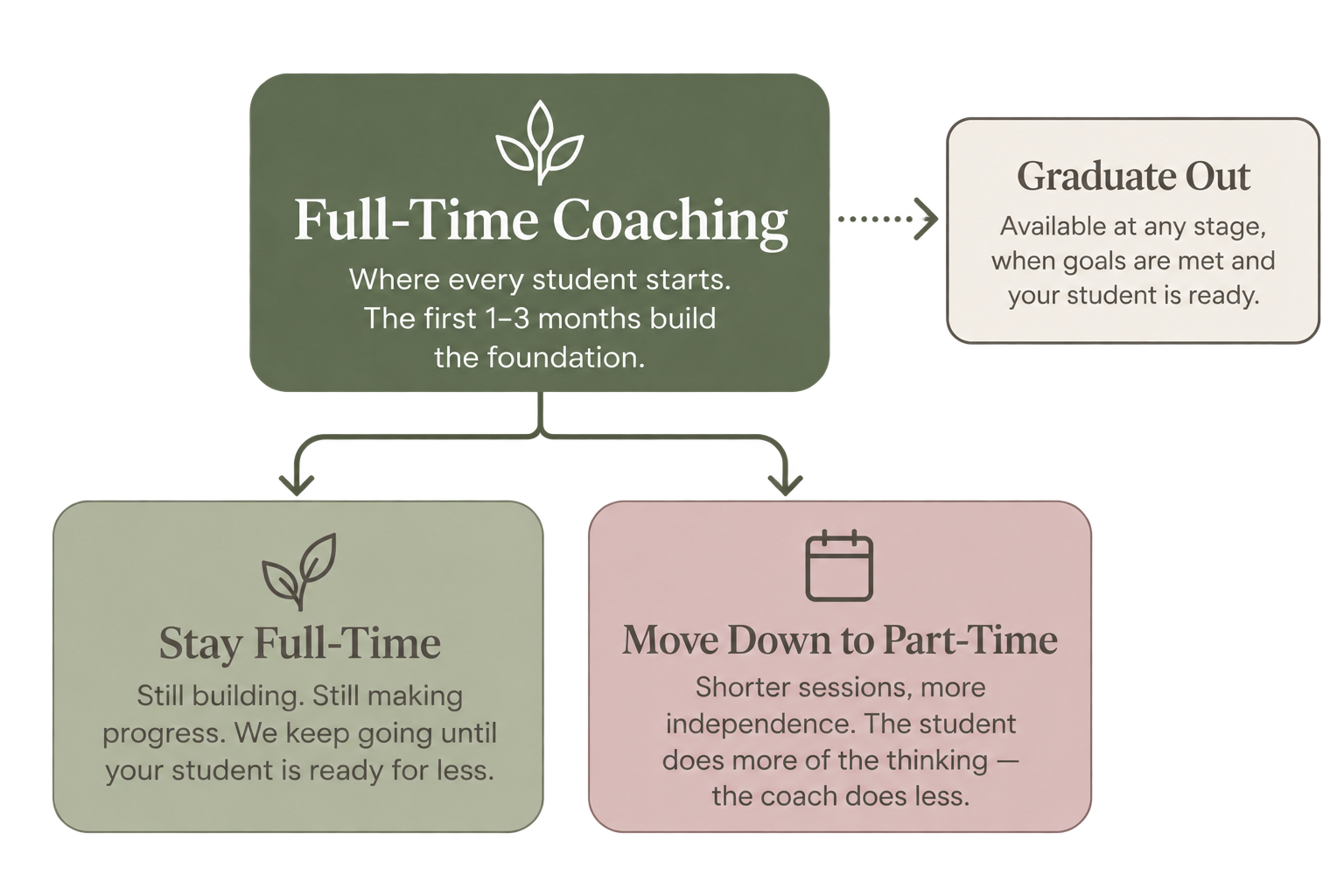
Every middle school student starts with Full-Time coaching for a minimum of one to three months. That’s where the coach builds a real relationship with your student, figures out where things are actually breaking down, and gets enough momentum going that the systems have a chance to hold.
After that, families can stay Full-Time or step down to Part-Time, and students can graduate out of coaching at any point along the way.
Start with a conversation
If you’re not sure whether coaching is the right fit, that’s a good reason to book a consultation, not a reason to wait. You can pick the coach who seems like the right match for your family and schedule a free 30-minute Zoom call with them directly. You’ll tell them what’s going on with your child, they’ll explain how coaching actually works, and you can ask whatever you want.
It isn’t a sales call or a coaching session, and nobody is assessing your child or trying to close you. It’s a conversation with a real person about whether this makes sense for your family, and if it doesn’t, that’s a fine outcome.