

Executive Function Coaching
for College Students and Young Adults
Nobody is checking whether your student went to class, and that is where things tend to start slipping.
High school had bells, attendance, and teachers who noticed when something was off. College has a syllabus handed out once in August with everything due for the next four months, and then very little follow-up. Nobody takes attendance or asks about the paper, so the first real feedback may be a midterm grade, and by then it’s November.
For a student whose executive function skills were being propped up by structure they didn’t build themselves, losing that structure changes everything. It’s the same student with the same intelligence, and suddenly they’re failing classes they’re perfectly capable of passing. It shows up outside of class too, in sleep schedules that drift past the point of repair, meals that get skipped, a dorm room or apartment that has gotten away from them, and a drop deadline that passed while they were avoiding thinking about it.
We’re ADHD-trained coaches who specialize in working with kids, teens, and young adults, and between the three of us we have more than 60 years of professional experience. We’ve seen this transition many times, and we know what helps. That’s what we work on.
Where we start
By this point most students have figured out that something isn’t working, but they usually haven’t figured out what, specifically. So we start by asking what was actually holding things together before, what disappeared, and where the week falls apart. It might be the planning, the starting, or the follow-through, and it’s often what happens in the hours before they finally sit down to do the thing.
Once a student can see their own pattern, they can build something that works without a bell schedule underneath it. From there we work on structuring unstructured time, planning across a whole semester instead of a week, keeping track of what’s due when nobody reminds you, and knowing when to ask for help before the drop date instead of after.
This is the age where it matters most that the systems are actually the student’s. We aren’t building something that works while a coach is watching, because the goal is something that holds up after coaching ends.

How parent communication works at this age
This is the piece that looks different from every other age group, and it’s worth reading carefully. Your student is a legal adult, so what gets shared with you, and what doesn’t, is a decision we make together at the very beginning, before coaching starts. That conversation includes you, your student, and the coach.
Some of the questions we'll work through:
Do you want to know if they're failing a class, or is that theirs to handle?
Should we schedule a parent check-in before the drop deadline each semester?
Is this fully independent, with billing being the only thing that involves you?
What happens if the coach becomes genuinely concerned about something?
There’s no default setting here. Some families want a monthly check-in and a heads-up if something is going sideways, and some students want complete autonomy and a coach who reports to nobody but them.
Both approaches work, and a lot of families land somewhere in between. What matters is that everyone agrees up front and knows what to expect, including your student, who needs to trust that the coaching space is actually theirs.
How coaching works at this age
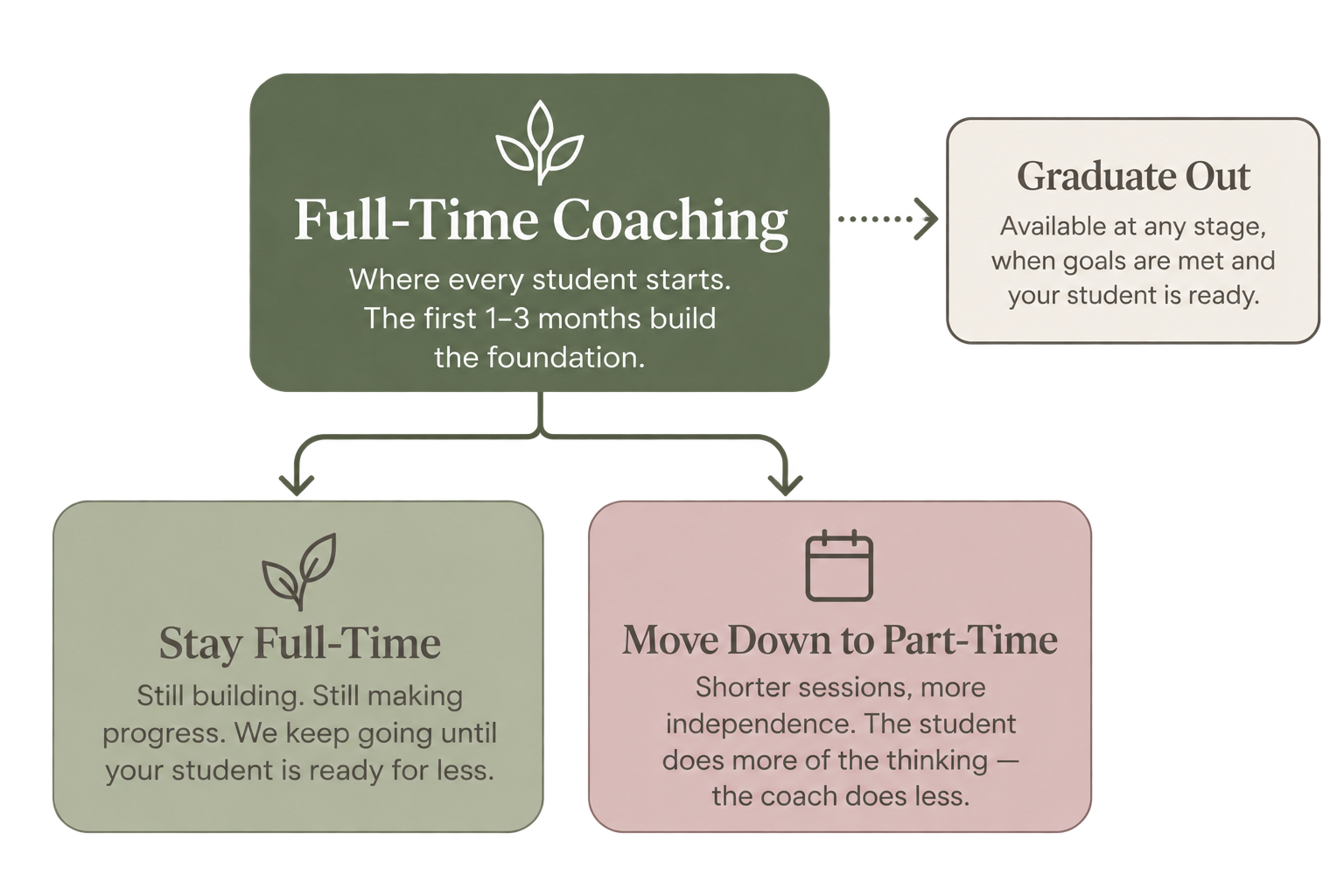
Every student starts with Full-Time coaching for a minimum of one to three months. That gives the coach time to build a real relationship with your student, figure out where things are actually breaking down, and get enough momentum going that the systems have a chance to hold.
After that, students can stay Full-Time or step down to Part-Time, and they can graduate out of coaching at any point along the way.
Start with a conversation
If you’re not sure whether coaching is the right fit, that’s a good reason to book a consultation, not a reason to wait. You or your student can choose the coach who seems like the best match and schedule a free 30-minute Zoom call with them directly. You’ll talk about what’s going on, they’ll explain how coaching works, and you can ask whatever you want.
It isn’t a sales call and it isn’t a coaching session, and nobody is assessing your student or trying to close you. It’s a conversation with a real person about whether this makes sense for your family, and if it doesn’t, that’s a fine outcome.