
Executive Function Coaching for High School Students

Your teen knows the deadline matters, and they still didn’t start until 11pm.
When you ask why, you usually get an “I don’t know,” which is frustrating to hear and is probably true. High school is where the stakes go up, because grades now follow them, there are five classes with five different portals, and a job, practice, and friends all compete for the same hours. Teachers have mostly stopped chasing missing work, and you’ve probably been told to back off and let them figure it out. Maybe you tried that, and watching it happen was harder than you expected.
At home it shows up in smaller ways. Your teen is twenty minutes late to everything, the alarm goes off six times before anything happens, and “I’m leaving in five minutes” turns into twenty-five. It isn’t because they don’t care. The part of the brain that handles planning, starting, and following through is still developing, and for a lot of teens with ADHD it’s developing on a different timeline.
We’re ADHD-trained coaches who specialize in working with kids and teens. Between the three of us, we have more than 60 years of professional experience with kids, and a lot of that has been spent with high schoolers who are exactly where your teen is right now. We know why the planner didn’t work, and we know what tends to help instead.
Where we start
By high school, most students have a story about themselves, and it usually sounds like “I’m bad at school” or “something’s wrong with me.” That story gets in the way more than any missing assignment does, so we start there.
We ask where things actually break down, what’s different about the classes that go well, and how long they really think an essay takes.
Once your teen can see the pattern instead of a character flaw, they can do something about it. From there we build the rest together, including planning backwards from a due date, breaking down work that feels too big to start, and figuring out what to do when the plan falls apart. The goal is for your teen to be able to run their own life in two years, when you aren’t there to check the portal.

How coaching works at this age
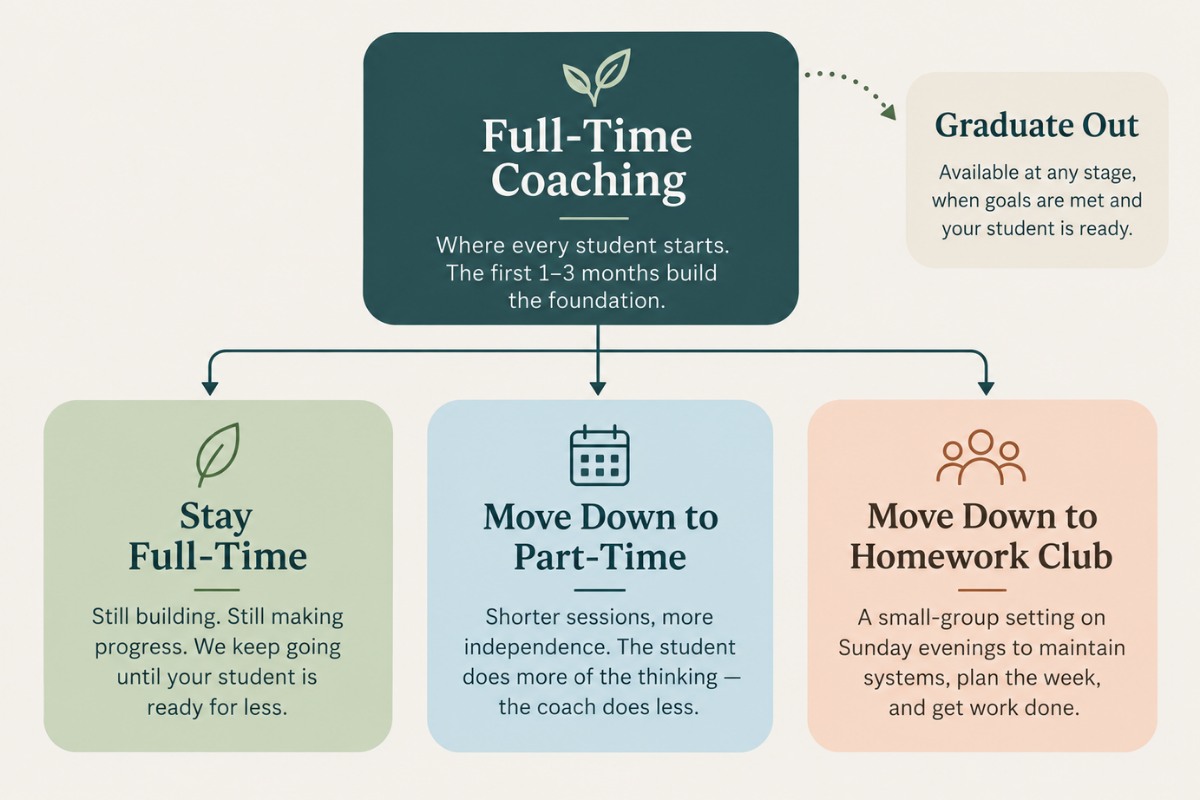
Every high school student starts with Full-Time coaching for at least one to three months.
That gives your teen’s coach time to build a real relationship, find where things are breaking down, and get enough momentum going that the systems have a chance to stick.
After that there are three paths: staying Full-Time, stepping down to Part-Time, or moving into Homework Club.
Students can graduate out of coaching at any point.
About Homework Club
Homework Club is where the systems built in individual coaching stay alive. Groups meet on Sunday evenings over Zoom with no more than four students.
The first half is for updating calendars, checking portals, and planning the week, and the second half is work time with the coach right there for anyone who gets stuck.
Sunday evening is on purpose, because it’s the moment most students with executive function challenges either skip or need an adult to force.
Homework Club isn’t tutoring and it isn’t a starting point, because students need the foundation from individual coaching first.
Start with a conversation
If you’re not sure whether coaching is the right fit, we offer a free 30-minute Zoom consultation with the coach you choose.
You’ll tell them what’s going on, they’ll explain how coaching works, and you can ask whatever you want.
There’s no pitch and no pressure, and if it isn’t the right fit, that’s a perfectly good outcome.